



6 Tips to Avoid Lung Squeezes in Freediving

Alexander Vinogradov shares his tips for technique, adaptation and protecting your lungs underwater for safe deep diving
By Deena Lynch
Contributor: Alexander Vinogradov and Oliver Christen-Drew
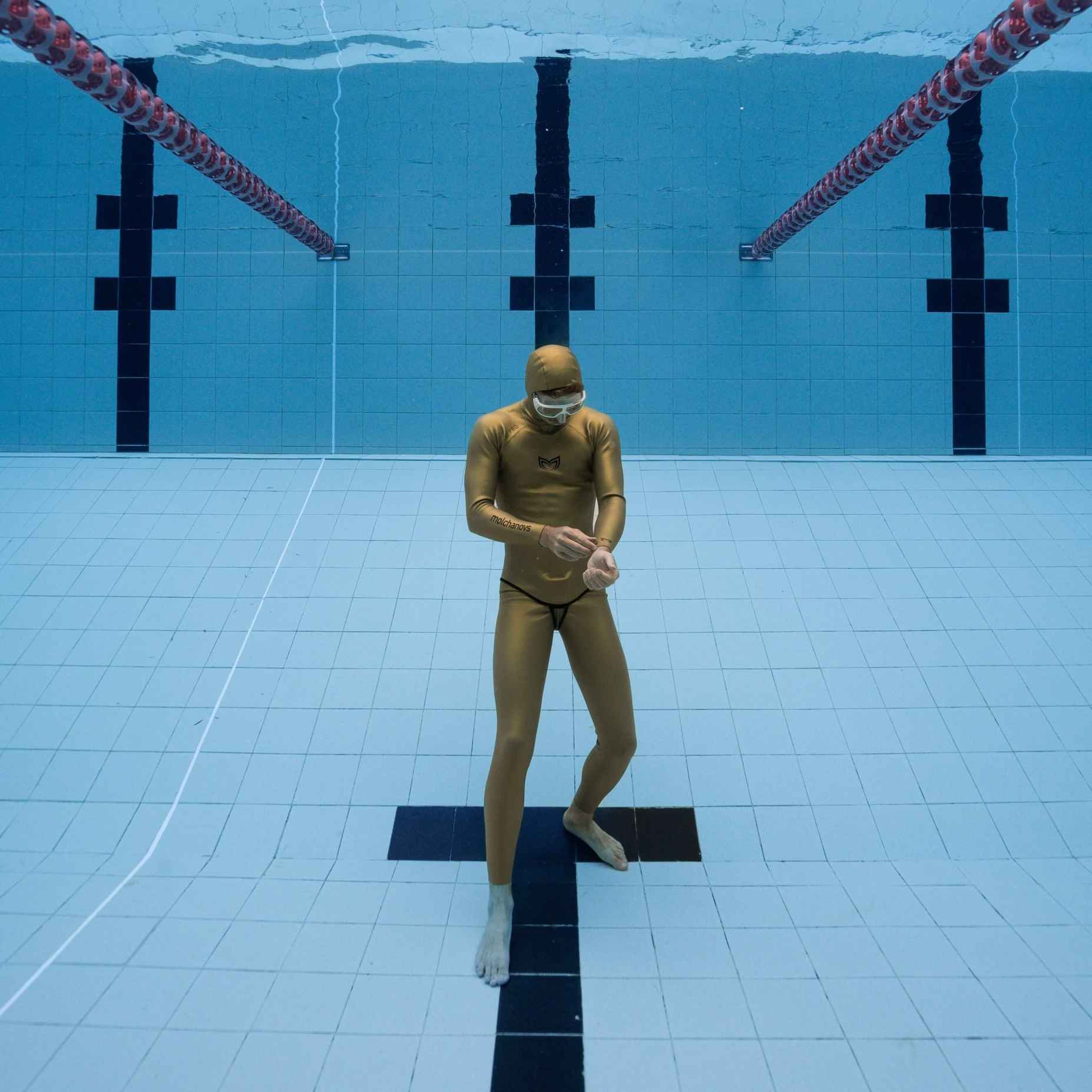
Vinogradov prioritises the health of his lungs on every dive throughout his exceptional athletic career © @maxime.souverain.
Pulmonary barotrauma, commonly called lung squeeze, remains one of the most misunderstood risks and injuries in freediving. With over 125m+ in depth during his competitive dives, and as vice-champion in Constant Weight (CWT) at the AIDA World Championship 2025, Alexander Vinogradov knows the realities of deep diving better than most. In this guide, he breaks down the 6 key principles that have helped him maintain healthy lungs throughout a high-performance career.
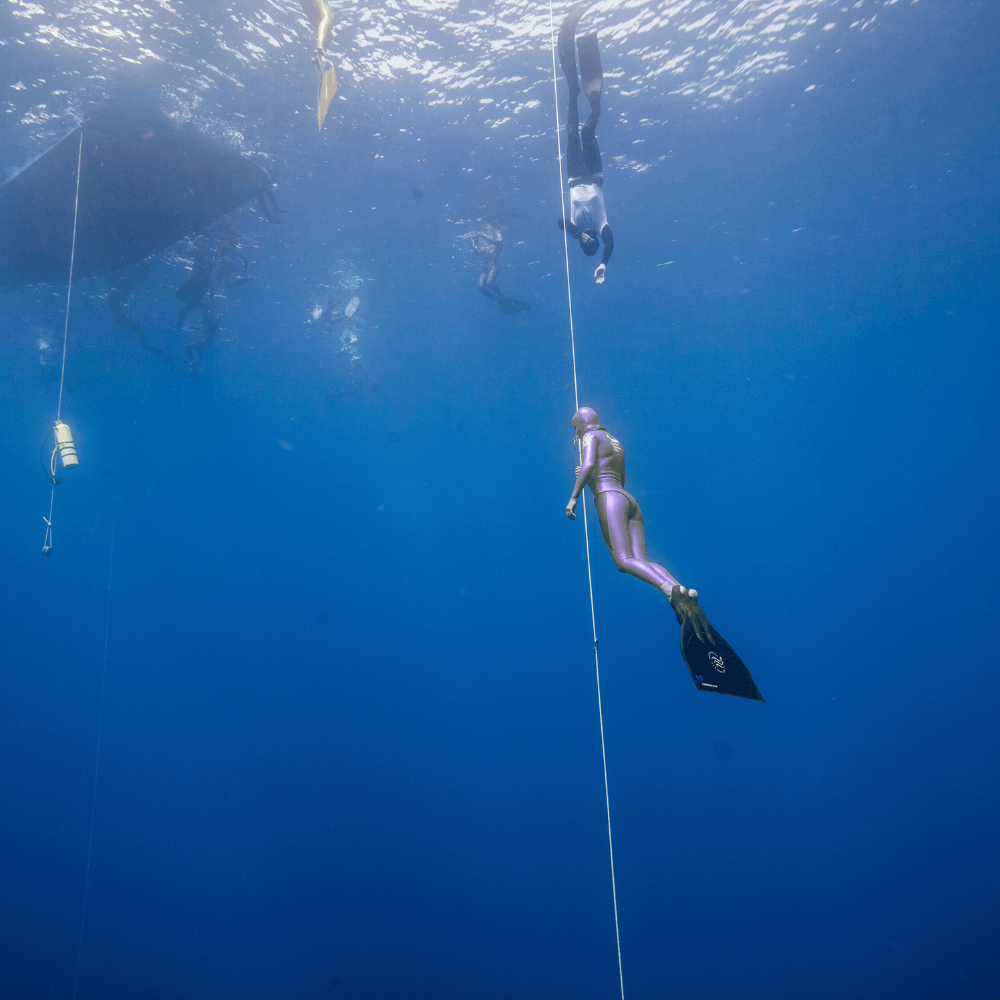
 Alexander Vinogradov gliding into the blue, combining world-class technique with calm, controlled descent. © @maxime.souverain.
1. Safely Develop Thoracic (Rib Cage) Flexibility
Chest mobility is the foundation for deep diving comfort. A flexible rib cage allows you to inhale more before the dive and enables the thoracic cavity to compress smoothly at depth.
Vinogradov recommends training flexibility in two directions:
- Inhale stretching: Light, dynamic stretches that open the chest and shoulders, improving your pre-dive inhalation capacity.
- Exhale stretching: Controlled exhale dives, diaphragm stretching, and dry rib-cage mobility work, such as Pranayama exercises like Uddiyana Bandha, to train the rib-cage to compress more freely.
In the Wave 3 and Wave 4 courses, we cover the basics of rib-cage flexibility training, including stretching, packing, reverse packing and physical conditioning.
And the golden rule? Never overstretch lung tissue. Progress slowly, avoid high-intensity static holds, and always perform exhale exercises with a buddy.
“If you want to dive deeper into this topic, I recommend the Foundational Breathwork program by Alexey Molchanov. You’ll get all the exercises needed to improve your chest flexibility and more,” Vinogradov adds.
2. Progress Gradually (And Don’t Be Afraid to Step Back)
Depth adaptation is both physical and mental. Increasing depth too quickly leads to mistakes, and mistakes increase the risk of barotrauma.
Alexander stresses the importance of:
- Letting your tissues adapt at their own pace.
- Repeating depths multiple times until they feel effortless.
- Increasing depth by 3–5 meters maximum and only when your lungs feel perfect.
- Reducing depth and rebuilding confidence after any break from deep diving (even short ones).
Before the 2025 World Championship in Limassol, Vinogradov fell sick and made the difficult decision to reduce his target depth. Even with the setback, he still secured a podium finish. “I saved my life and health and that is the most important result,” he says.
3. Build Trust in Your Equalization Technique
Equalization and relaxation are inseparable. If all your mental bandwidth goes to your ears, it becomes easy to lose body awareness, and sharp or uncontrolled movements can contribute to lung squeeze.
To reduce risk:
- Practice until your equalization becomes reliable and automatic
- Maintain a stable, consistent mouthfill to prevent reverse-flow or pressure drops
- Use your freed-up attention to stay relaxed, long, and streamlined in the water
Proper equalization doesn’t just protect your ears! It protects your lungs by preventing sudden intrathoracic pressure changes and unnecessary strain. Build trust in your equalization technique through consistent dry training using the Molchanovs EQ Trainer 2 which comes with video instructions and exercises. In our Wave 4 course, we teach you how to prepare for and compete in official freediving competitions effectively and cover how to master equalization with advanced equalization techniques and practice. Find more information about the course here.
 Vinogradov’s relaxation keeps his deep dives smooth and safe. © @daanverhoevenfreediver.
4. Don’t Overpack…And Exhale Before Surfacing
Use packing only when the amount of air in your lungs is the sole limiting factor of your diving. Do not use packing as a short-cut to compensate for other shortcomings which you can work on first, such as lack of thoracic mobility or unrefined equalization technique. Packing is an advanced technique and should be taught by an experienced Wave 3 instructor and practiced under guidance to avoid injury. Additionally, overpacking overstretches the lungs, increasing the risk of tissue damage. Vinogradov avoids it entirely with one crucial habit:
Remember to exhale in the final meters of ascent.
As you ascend, blood shift increases the total volume of fluids and air inside the chest. When that air expands near the surface, pressure rises rapidly. Forgetting to exhale can create dangerous internal strain.
Alexander sets a depth alarm to remind himself. “Most of my lung overstretching problems came not from squeeze, but from forgetting to exhale,” he admits. “A simple notification solved it.”
5. Respect Warning Signs (Even the Subtle Ones)
Not all barotrauma presents with visible symptoms. You might not cough or see blood, yet still have internal stress or micro-injury.
If you experience:
- Tightness
- Discomfort
- Unusual sensations
- Reduced oxygen saturation
Take it seriously.
Skip the next dive, evaluate your technique, and rest. Patience and honesty with yourself are essential skills. “Bleeding… is not normal,” Vinogradov says. “Your priority must always be avoiding damage, not chasing depth.”
Developing awareness and making smart decisions to protect your health is what defines a mature freediver.
6. Treat Lung Health as a Core Skill, Not an Afterthought
At the elite level, longevity matters more than numbers. Vinogradov emphasizes that lung health is not an optional detail but is in fact, a foundational skill for any freediver.
Understand the mechanics, know your limits, build recovery into your training, and develop habits that support long-term progression. Safe diving is sustainable diving.
Never consider lung health an afterthought; treat it as one of your core freediving competencies.
Final Note
Do not attempt drills beyond your current training level. If you’ve never heard of or practiced Pranayama exercises like Uddiyana Bandha or Kapalabhati, or FRC/exhale dives, you may not yet be ready to perform these safely without supervision.
Find your closest Molchanovs Instructor or school to develop these skills properly, or explore the Foundational Breathwork program with World Champion Alexey Molchanov to build a safer, stronger foundation from home.
Disclaimer: The information provided in this article is for educational purposes only and is not a substitute for formal instruction.
Advanced techniques mentioned here including exhale dives, FRC dives, diaphragm stretching, Uddiyana Bandha, Kapalabhati, rib-cage mobility work, equalization training and depth-adaptation practices should only be performed by divers who are:
- Certified to the appropriate Molchanovs Wave level for these skills, and/or
- Training under the direct supervision or guidance of a certified Molchanovs Instructor.
Never practice advanced exercises alone, in unsafe conditions, or beyond your current certification and experience level. Always follow established buddy protocols, dive conservatively, and prioritise your safety and long-term health.
Leave a comment