
From Chronic Pain to World Champion: Bevin Reynolds’ Freediving Journey

After years of chronic pain and a devastating accident, Bevin Reynolds found her way back through the one place she’d always felt free: the water.
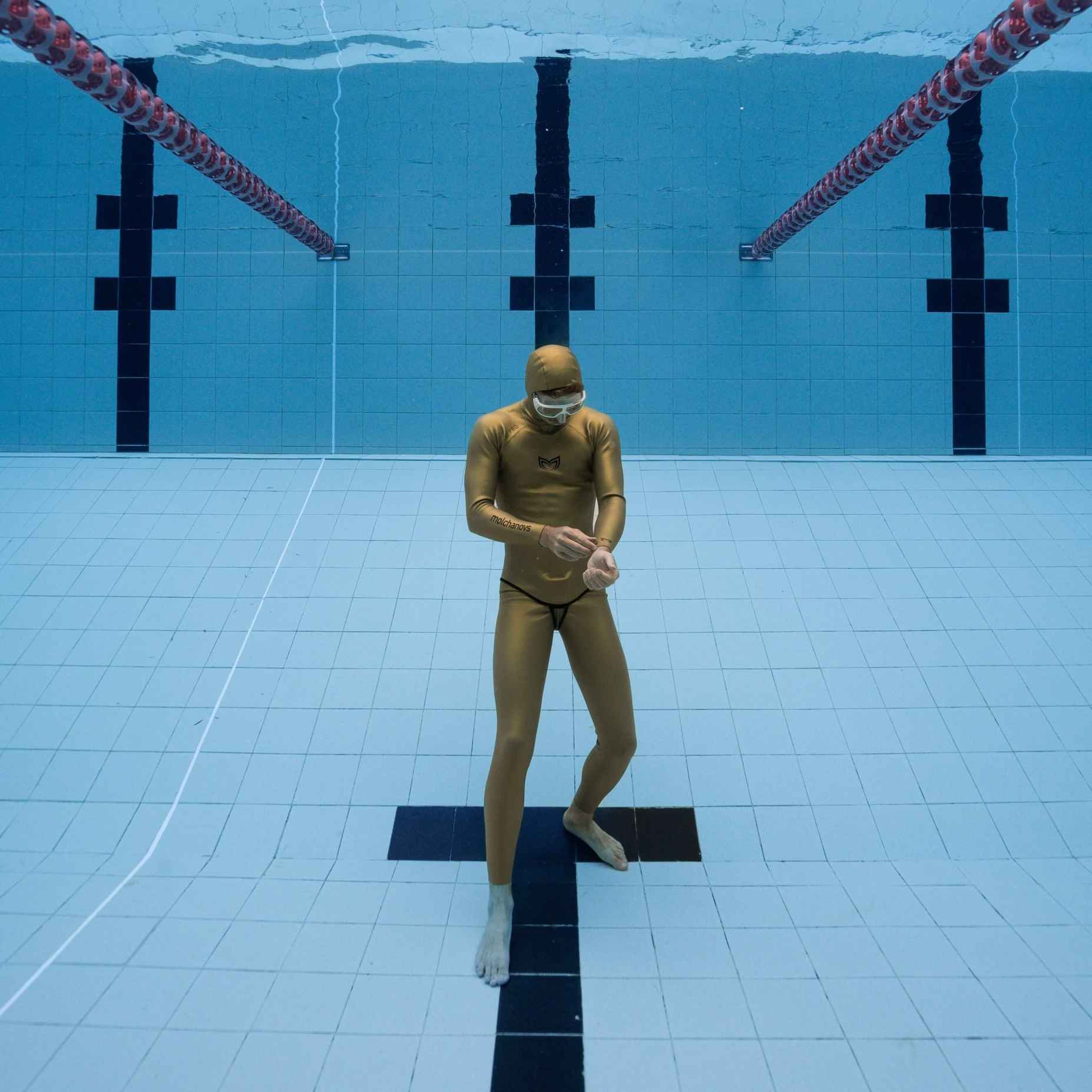
Bevin Reynolds’ story is one of patience, persistence, and learning to trust one’s body again. Photo credit © Linda van der Colff.
For Bevin Reynolds, the water has always been more than a place to train.
It’s where she feels most comfortable. Where discipline, ambition, and stillness meet. Where a body that can feel difficult to live in on land becomes powerful, capable, and free.
Bevin lives with scoliosis and chronic pain, a reality that shapes the way she moves through daily life. Standing for too long, sitting in certain positions, carrying the wrong bag, or walking for extended periods can all bring discomfort. On land, she has to plan ahead. In the water, things feel different.
“The water is the only place where I am truly comfortable in every way,” she says. “Hence my pull towards it and water-related sports and recreation.”
Long before she became one of South Africa’s top freedivers, Bevin was a swimmer with Olympic dreams. When she realized she wasn’t quite fast enough to reach that level, life moved on. She studied, worked, and spent nearly 16 years away from competitive swimming.
Years later, daily pain led her back to movement. After realizing how much her scoliosis was affecting her life, she began corrective work for her spine with a scoliosis-focused yoga teacher. Soon after, she returned to the pool.
Not long after that, she found freediving.
What followed was a remarkable athletic story: a rapid rise through the sport, national records within months, a devastating motorcycle accident, ACL reconstruction, a long rehabilitation process, and eventually, a return to elite competition.
Her recent overall win at the AIDA World Apnea Pool Championships, along with multiple continental records, is part of that story.
But it’s not the whole story.
The more powerful message is what it took to get there.
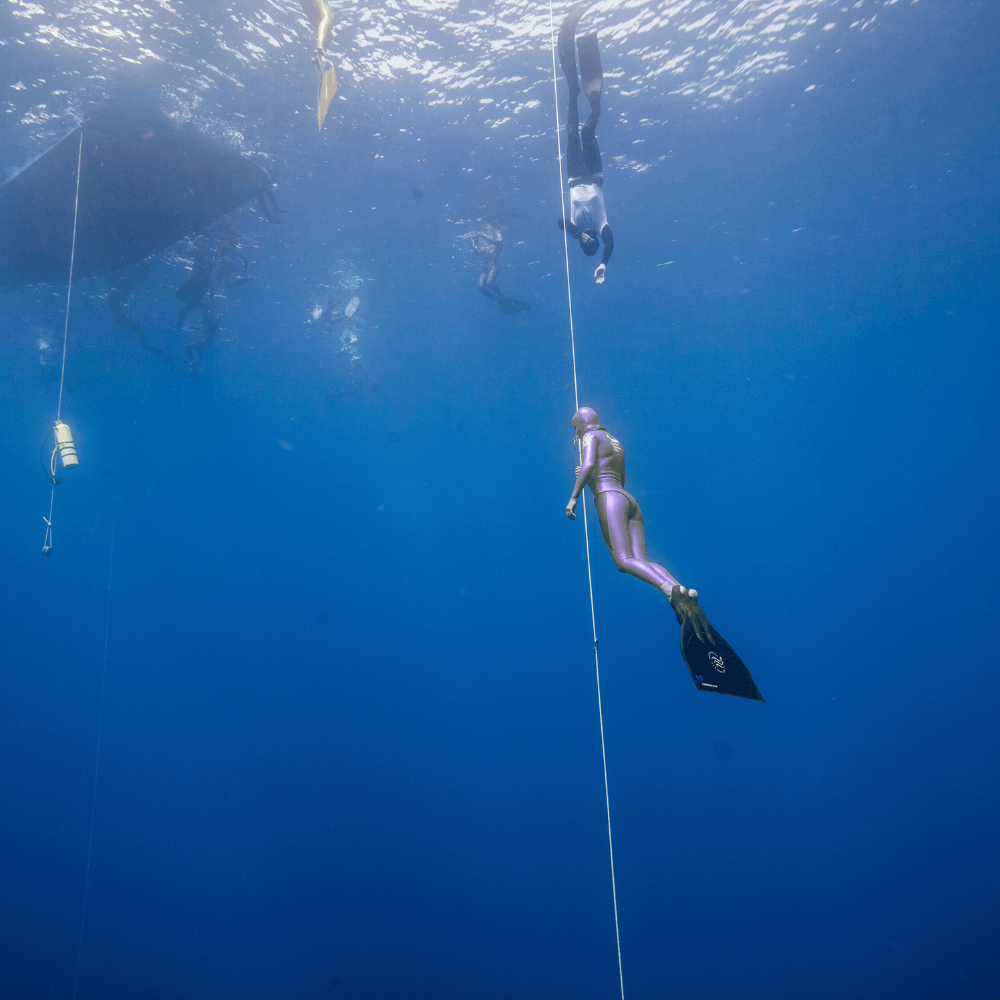
 In the water, Bevin Reynolds found a place where movement felt natural, powerful, and free. Photo credit © Marc Thoreson.
Finding freediving
In November 2022, Bevin was invited to a Surf Apnea workshop at a local freediver’s swimming pool. The owner of the pool saw her swimming and said something that stopped her in her tracks.
“You are going to break all the records.”
Bevin didn’t know what he meant at the time, but her curiosity was piqued.
The next Level 1 freediving course was still two months away, so she began researching. She read, listened to episodes of The Freedive Café, and started learning about the sport before she’d even taken her first course.
Then, while listening to Alice Modolo’s episode, something clicked.
“Something about what and how she shared brought up a lot of emotion for me,” Bevin says, “and I remember thinking: ‘This is it. This is what I want to do.’”
Once she completed her course, Bevin started training pool sessions the very next week. Freediving seemed to meet every part of her personality at once.
“I love the water,” she says. “It is my happiest place and always has been. Then I love training and living a disciplined lifestyle. I thrive on having ambitious goals and striving for them. I truly love the competitive side of it.”
She was also drawn to both the science and the more introspective, yoga-like elements of the sport.
“I am also a real nerd when it comes to both the ‘yoga’ and the science of freediving,” she says, “so it seems to have captured my mind, body and soul’s attention in all ways possible.”
For someone living with chronic pain, the water offered something rare: ease. On land, Bevin has to think carefully about her working position, what bags she uses, how she trains, and how she manages recovery. Freediving, strength training, and mobility work have all helped tremendously, but pain and discomfort are still part of her daily life.
In the water, though, Bevin found a place where movement felt different — and where her body could feel strong, capable, and free.
A rapid rise
Bevin’s progression in freediving was immediate.
In the first three months after her Level 1 course, she trained with Evan Walther, who was a USA record holder at the time. Each week, she found herself diving farther while still feeling calm, controlled, and clear.
“I was seeing that every time I did a longer dive, I was still very much in control and not experiencing any hypoxic symptoms,” she says. “So I kept diving further and further each week.”
Three months after starting, she entered her first competition and set her first two South African national records in Dynamic No Fins and Dynamic With Bifins. Three months later, she broke them again at South African Nationals.
Then Evan sent her the women’s results from World Championships. Based on the distances she had already done, Bevin would have placed fifth or sixth.
“It was then that I truly knew,” she says.
 For Bevin, freediving is where ambition and stillness meet. Photo credit © Linda van der Colff.
When everything changed
Bevin’s rise in freediving was fast, but the path was anything but linear.
Three months after her first World Championships, where she’d experienced what she describes as a real success, she was coming home from the gym on her scooter when a minibus driver drove into her.
“It was my right of way and he hadn’t seen me,” she says. “I was on a scooter so wasn’t protected at all.”
She felt the pain in her knee immediately.
“I remember thinking that it was very serious,” she says. “I knew then that I wouldn’t be able to go to World Champs the next year.”
A month later, she underwent ACL reconstructive surgery. Physically, it was the most painful thing she’d ever experienced. Emotionally, it brought grief, anger, and the loss of everything she’d imagined might be possible after her first World Championships.
“The loss of all that I had imagined would be possible after Worlds was emotionally devastating. I had a lot of grief and anger to work through.”
Learning to walk, run, and swim again took months. The surgery was only the beginning. Progress came gradually, and not always in a straight line.
“The hardest part was probably just how slowly it can go,” Bevin says. “And also how unprepared I was for what it would all feel and be like. I didn’t imagine just how much of a rollercoaster of emotions it would end up being.”
Still, she never completely doubted that she’d return to freediving.
Even while bedridden, and later while on crutches, she focused on static apnea. For about five months, she trained six or more sessions a week in bed or in the pool.
“I knew I would be able to get back to freediving,” she says. “Despite how low I felt psychologically, I was mostly uncertain if I would be able to get back to the level I was at before the accident and surgery.”
No one comes back alone
Freediving is often described as an individual sport. In competition, the athlete is the one who takes the breath, starts the dive, and completes the performance.
But no freediver reaches that moment alone.
For Bevin, the road back was shaped by the people around her. In the early stages of recovery, her partner at the time, her friends, her mother, and the Cape Town freediving community were deeply supportive. In the past year and a half, her current partner, Linda, has become an essential part of the journey.
“She has been the most exceptional support,” Bevin says. “She has been my number one fan and training buddy through every session I did, including many 5 a.m. wake-ups.”
That support looked like training sessions, meals, massages, many strategy sessions, and a strong belief when Bevin was struggling to hold onto her own.
“Their continued belief in me, and words of encouragement whenever I felt doubtful, sad, or uncertain, gave me hope and lifted my spirits,” she says.
Her support system saw the parts of the comeback that a results list never could: the anger, sadness, fear, uncertainty, and the long grind of rehabilitation after surgery.
“Recovery is pretty arduous,” Bevin says. “The surgery is really just the beginning of getting back on track. All the work comes after that.”

The surgery is really just the beginning of getting back on track. All the work comes after that.” Photo credit © Linda van der Colff.
Where the journey led
By the time Bevin arrived at the 2026 AIDA World Apnea Pool Championships in Budapest, the competition was about more than medals.
She was focused on process. If she could deliver personal bests, she knew she’d be satisfied. She was also more mindful than ever about recovery between performances: sleep, nutrition, hydration, nervous system regulation, and listening to what her body needed.
Across the competition, Bevin came away with a bronze, two silvers, the overall women’s title, and multiple continental records. But when she looks back, the thing she’s most proud of isn’t one single dive.
It’s her consistency.
“My consistency throughout all aspects of the competition,” she says. “Before and during the actual performances.”
Before a big dive, Bevin says her mind naturally becomes quiet. She focuses on her preparation, then reaches a point where she can surrender to the work already done.
“I like to smile and connect to feelings of gratitude for the opportunity to dive at such a high level,” she says.
The emotion of the comeback hit her after Heike Schwerdtner’s Dynamic With Fins performance. At that point, Bevin knew she had the points she needed for the overall title.
For the outside world, that title might look like a single victorious moment. But for Bevin, it was the result of months of deliberate, almost devotional work.
“Maybe the religiosity that went into training and taking care of my mind, heart, and body in the months leading up to competition,” she says. “That journey was the most intense part as I truly gave all I could to be physically and psychologically prepared.”

More than the medals, Bevin Reynold’s competition performances were a testament to the dedication and discipline it took to overcome her setbacks. Photo credit © Linda van der Colff.
More than a comeback
It would be easy to tell Bevin’s story as a simple arc: pain, accident, recovery, victory.
But real stories are rarely that clean.
Bevin’s story is also about returning to the water after years away from sport. It’s about learning to care for a body that requires attention and patience. It’s about finding a discipline that meets her physically, mentally, emotionally, and intellectually. It’s about talent, but more importantly, consistency.
Her World Champs result isn’t the whole story. It’s the evidence of everything that came before it.
For anyone living with pain, injury, or a major setback, Bevin’s advice is simple: keep doing the thing you love.
“You will either find that it feeds your mind, body and soul regardless of whether it wins you titles, medals or records,” she says, “or you’ll end up doing something extraordinary regardless of what has happened to you. Or both.”
If Bevin’s story inspired you to begin your own competitive freediving journey, the Molchanovs Wave 4 course is the perfect starting point. Subscribe to the Magazine for the latest articles, freediving tips, competition reporting and athlete stories.
Leave a comment